‘Supposed to be a safe place’: Parents, state leaders weigh in as home visits from activists rattle child-care providers
State officials have publicized guidance for child care providers on how to respond to and report unwanted visits.


San Diego Union-Tribune
 gqlshare
Source: Wayback availability API
Days after a well-known YouTuber and other content creators visited San Diego child care providers’ homes, state officials are denouncing what they say is targeted harassment of providers — especially those of Somali descent — and are advising them on how to report the unwanted visits.
Citing harassment, state Attorney General Rob Bonta this week publicized guidance for providers on how to report possible hate crimes and for law enforcement on investigating them. He noted it’s a hate crime in California if someone is targeted for their actual or perceived nationality, including immigration or citizenship status.
The guidance comes weeks after providers warned of ongoing harassment at a press conference with elected officials in Rolando, and days after a visit to San Diego earlier this month from internet video creator Nick Shirley.
Shirley has drawn nationwide attention for a December video focused on care providers in Minnesota, where allegations of fraud in public benefits programs had previously prompted state and federal investigations. The Trump administration has used such claims to justify its deadly immigration crackdown in that state.
Shirley has not released any video from his San Diego visit. He did not immediately respond to a request for comment.
The local conservative activist who accompanied him, Amy Reichert, alleged last month that some providers may be receiving child care subsidies while not serving children and therefore may be committing fraud. The state Department of Social Services, child care providers and local child care agency officials have said such claims are based on flawed interpretations of state inspection records.
Still, multiple San Diego County child care providers say that strangers have visited their home-based businesses and recorded them without their consent, while demanding to see children in their care.
The encounters have stirred fear and anxiety among providers and uproar from community advocates and local and state leaders.
“Reports that pseudo-investigators are stalking and intimidating San Diegan childcare providers at their homes and places of business are extremely alarming,” Bonta said in a statement this week. “Our childcare providers do critical work and are the backbone of what makes life possible for many working families. These internet vigilantes are harassing Californians and seeking to alienate folks from their neighbors and communities, right out of the Trumpian playbook.”
Several San Diego Democratic state lawmakers have also condemned the unwanted visits.
“We cannot tolerate the targeting of children or the harassment of child care providers based on reckless, unfounded claims of fraud in California,” said state Sen. Akilah Weber Pierson in a statement. “This kind of extreme propaganda disrupts the health and safety of children, their families, and the child care providers our communities rely on.”

The state social services department, local community groups and the United Domestic Workers union that represents local child care providers have been advising providers on how to keep children safe and how to respond if a stranger comes to their home to film or demand to see the children in their care.
The state department sent out a bulletin two weeks ago advising child care providers on how to keep children safe. It reminded providers that a state department inspector will introduce themselves and show them their state ID badge. And it said providers should call 911 or the police if there’s an immediate security, safety or health incident, and it encouraged providers to report the incident to the department.
Grecia, a San Diego mother whom the Union-Tribune is identifying only by her first name because she fears harassment, sends her 18-month-old to a Somali child care provider, Safiyo Jama, in City Heights who was visited by Shirley and separately by another man who recorded her.
Grecia’s son was there at the time of Shirley’s visit. “I just couldn’t believe it. It was just surreal,” she said.
Grecia and her husband have relied on Jama since their son was six months old. They were careful to choose a provider for their firstborn and chose Jama because “it felt like dropping your kid off at grandma’s.”
“She’s very loving and caring. She gives them gifts for their birthday,” Grecia said. “She became family for us.”
When she learned Shirley had visited her son’s child care, Grecia said she became angry at the “entitlement” of anyone expecting to be shown children — and worried for the children’s safety.
“It’s unfortunate to see that this is happening to families that are immigrants who are contributing to this country,” Grecia said. “I see the effort that (Jama) puts into taking care of those kids.”
Brittney, an East County mother whose 2-year-old son also goes to a child care visited by Shirley and who also fears harassment, said his visit left her anxious for her child’s safety, and for her provider’s.
She has sent her son to this provider for the last two years, after it took her half a year to find a provider she could trust.
“It’s sickening. It kept me up at night,” Brittney said. “This is supposed to be a safe place.”

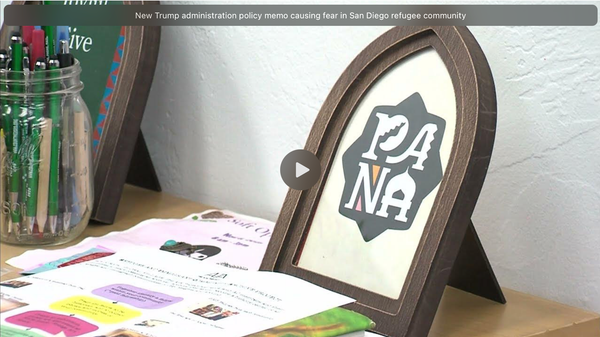
Homayra Yusufi, senior policy strategist with the Partnership for the Advancement of New Americans, or PANA, has spoken with providers who told her they’re leaving home, staying with friends or going to hotels. Some parents are also taking their children out of child care, she added.
“They’re terrified for their children as well,” she said. “Imagine having these creepy strangers outside your child’s daycare, harassing and filming.”
Shirley’s Minnesota video has prompted others to visit and record video of child care providers in San Diego in recent weeks.
One of them was Habiba Mohamed, who has been providing child care to San Diego families since 2012 and now serves eight children out of her College Area home.
Mohamed was locking the door to her home on a recent Sunday afternoon when a man and a woman she didn’t know walked up the stairs of her apartment building and came to her.
Mohamed said the woman told her to open the door because they wanted to see the children in her care.
“That’s all I said — ‘What?’ — and I kept in the stairs,” Mohamed said. “That’s when they pulled out the cameras and started filming me.”
The man was a San Diegan named Daniel La Salle, one of a number of video creators following Shirley’s lead.
While recording Mohamed, La Salle kept asking her if he could enroll his son in her child care and if there were any children present, saying he didn’t see any, according to a video that Mohamed simultaneously recorded of La Salle.
As she was walking out of her building, Mohamed told him she was on her way to pick up the kids for her child care and that her business was currently at capacity. She did not let him into her home.
“They’re only supposed to come in if they have a background check or they are from the state,” Mohamed said.
La Salle posted his video of her on multiple social media platforms.
When asked for comment, La Salle said he believes visiting and recording at a provider’s home can constitute harassment if it’s targeted, repeated or intimidating, such as if the person stays on the property after being asked to leave. He said he thinks there needs to be protection for providers and families from “genuinely harassing or intimidating behavior” while at the same time there needs to be oversight.
“My criticism in videos is not ‘you wouldn’t let a stranger see children,’ it’s when everything taken together — no observable child activity during stated hours, inconsistent explanations, no parent access and no objective indicators of operations — raises a fair question about whether the program is actually serving kids at all,” La Salle said in an email.
As for Mohamed, her business was last inspected in June. Zero deficiencies were found. Three children were present at the time of the inspection, and the inspector found she had proper supervision, safety measures and employee and child records in place.
After her encounter with La Salle, Mohamed says she couldn’t sleep for two days. She tried scrubbing her business from Google listings to no avail, but she said she managed to remove her phone number and mark her business as closed.
“Now I just have to look over my shoulder,” she said. “It’s just unbelievable.”
Mohamed, who is Somali American, has lived in San Diego for 30 years; she earned her bachelor’s and master’s degrees from San Diego State University.
It’s unfair, she said, that activists are targeting her community.
“Why Somalis?” she said. “Just because we’re dark-skinned? I don’t know. Just because the president talks about us all the time? This is not right.”